
Onion prices had peaked to Rs 57 per kg on August 22.

The wholesale prices of food items surged by 15 per cent during the week ended on September 26 against the same period last year, the government's inflation data shows.

The Producer Price Index will be better able to measure the average change over time in the sale prices of domestic goods and services, the Reserve Bank Governor said.
However, WPI inflation remained in double digit for the third consecutive month in July, mainly due to a low base of last year. WPI inflation was (-) 0.25 per cent, in July 2020. "The high rate of inflation in July 2021 is primarily due to low base effect and rise in prices of crude petroleum and natural gas; mineral oils; manufactured products like basic metals; food products; textiles; chemicals and chemical products etc as compared the corresponding month of the previous year," the commerce and industry ministry said in a statement.

It would not be surprising if India, the world's largest producer of milk, has to resort to imports to meet the elevated summer demand, states Surinder Sud.

From the Sensex pack, Infosys, Hindustan Unilever, Reliance Industries, ICICI Bank, Larsen & Toubro, Asian Paints, Nestle, Axis Bank, Wipro and Kotak Mahindra Bank were the major gainers. JSW Steel, State Bank of India, Tata Steel, Bajaj Finserv, UltraTech Cement, IndusInd Bank, Tata Motors and Bajaj Finance were the major laggards.
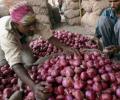
The government on Saturday imposed a 40 per cent duty on the export of onions to increase domestic availability amid signs of increasing prices. The export duty, which is the first time ever on onion, has been imposed as the retail sale price of the kitchen staple, according to government data, touched Rs 37/kg on Saturday in Delhi. The finance ministry through a Customs notification imposed a 40 per cent export duty on onions till December 31, 2023.

India's wholesale price-based inflation is at a 30-year high, leading to a "very alarming" situation for the country, former World Bank chief economist Kaushik Basu said on Thursday. He, however, doesn't see any risk of hyperinflation, but cautioned that if retail inflation follows wholesale prices, it might lead to "inflationary crisis". Participating in a virtual event organised by the Asia Society, India, Basu said the inflationary situation in India is at a "very risky bend".

Potato, a daily consumable vegetable, witnessed maximum inflationary pressure at 60.58 per cent

For manufactured products, the wholesale inflation was at (-)0.84 per cent in October 2019.

The central bank is widely expected to increase the repo rate by 25 basis points on Tuesday to 7.75 per cent to fight inflation even as it continues to unwind its rupee defense steps, a Reuters poll showed.

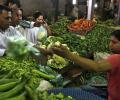
Onion prices both in wholesale and retail markets in most parts of the country have seen a sharp increase since July.
In view of declining inflation and recessionary conditions, the Planning Commission expects industry to cut prices in the normal course to battle economic slowdown.

Mahindra & Mahindra was the top laggard in the Sensex pack, sliding 2.05 per cent, followed by Bajaj Finance, Tata Steel, SBI, Asian Paints, Kotak Mahindra Bank and Titan. However, IT majors HCL Technologies and TCS defied the trend and gained 1.02 per cent and 0.47 per cent, respectively. FMCG firm Hindustan Unilever rose 0.32 per cent.
The rapid deceleration in prices has ignited a debate in New Delhi whether Asia's third-largest economy is heading towards deflation.

Onion prices on Thursday eased by Rs 10 to quote at Rs 60-70 a kg in the metropolitan cities of Delhi, Mumbai and Chennai, owing to an up to 52 per cent fall in wholesale prices in last three days following steps unveiled by the Centre to boost domestic supply.

In upmarket colonies, the bulb, a key ingredient in many Indian dishes, cost as high as Rs 70-80 a kg.
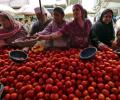
Though onion prices have begun downhill journey in major cities, citizens across the country continued to be battered by high rates of other important vegetables--tomato and garlic-- whose rates have soared astronomically across the country.

'The nominal GDP growth assumption for FY25 may be revised upwards on higher growth expectations.'
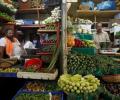
Since March 2020, WPI food inflation rate continued to fall but the CPI-food inflation rose, signaling a breakdown in supply chain from the mandis to the final household.
The food-price segment in the WPI has been growing at 8.3 per cent, much higher than the rise in the index for manufactured articles. In fact, segments like minerals and fuel have witnessed a decline in the WPI and have pulled the inflation down. The rise in food prices affects the common man more than the increase in prices of any other item.

India's headline retail inflation is expected to moderate further in the months to come, as low wholesale inflation will transmit to consumer prices, the Ministry of Finance said in its latest monthly economic review (MER) on Monday. "Inflationary pressures eased in February, with slight moderation in Consumer Price Index (CPI) inflation and Wholesale Price Index (WPI) inflation softening to a 25-month low. "With WPI inflation easing, its transmission to CPI inflation is soon expected," the MER for February said.

WPI inflation, which was in the negative zone from November 2014 to March 2016, has been on an upward trend for the seventh straight month

Maruti Suzuki, Hyundai and Tata Motors reported their highest-ever dispatches to dealers last fiscal, enabling the domestic passenger vehicle industry to log in best-ever performance to date. The country's largest carmaker Maruti Suzuki India reported its highest wholesales to date at 19,66,164 units, up 19 per cent from 16,52,653 units in 2021-22. Its domestic dispatches rose to 17,06,831 units in 2022-23, up 21 per cent from 14,14,277 units in 2021-22 fiscal.Hyundai Motor India said its overall wholesales last fiscal were the highest ever since commencing operations in the country.
After years of high food prices, India is now witnessing a deflation, according to the government's food inflation data.

The WPI inflation currently is ruling around 8.6 per cent. He said the duties like 5 per cent import duty on crude oil was abolished when international crude price touched a record high of $147 a barrel.

Inflation in food articles during June stood at 2.04 per cent, as against 1.13 per cent in May.

Food inflation rose for the third successive week and moved closer to 18 per cent in the week ended January 30.
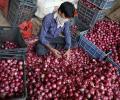
In a significant move to control spiralling onion prices ahead of the festive season, the government will transport 1,600 tonnes of buffer stock via railways from Maharashtra to Delhi - the first such initiative using rail transport for the kitchen staple. The special rake, dubbed 'Kanda Express', will depart from Maharashtra's Lasalgaon Railway Station and reach Delhi's Kishanganj Railway Station on October 20, Consumer Affairs Secretary Nidhi Khare announced on Thursday. The government expects this bulk movement to help stabilise prices in the Delhi-NCR region, where buffer stock onions are currently being sold at a subsidised rate of Rs 35 per kg.

Consumer price-based index of products consumed by agricultural labourers rose to 17.21 per cent in December compared to 15.65 per cent in previous month, a Labour Bureau statement said on Wednesday. However, inflation measured by wholesale prices was 7.31 per cent in December.

The prices of food items like mutton rose by 14 per cent, arhar by 9 per cent, gram by 4 per cent, fruit and vegetables by 2 per cent during the week. However, a major decline was registered in mineral index, as prices fell by 16.8 per cent mainly due to softening iron ore prices by 24 per cent and felspar by 3 per cent.
The price rise in individual key food commodities over the last one year is significantly higher than what is conveyed by the wholesale price index. While the latest government data show inflation at 6.68 per cent for the week ended March 15, the price change in most food items is in double digits.

Mahindra & Mahindra was the biggest gainer on the Sensex chart, rising 2.56 per cent, followed by Tata Steel, Tech Mahindra, Nestle, Power Grid, Infosys, HCL Technologies, Axis Bank, UltraTech Cement and L&T. In contrast, Asian Paints, ITC, Bajaj Finserv, Bharti Airtel and Tata Motors were among the laggards.
The increase by more than three per cent is largely due to jump in the rate of inflation in the case of WPI for fuel, power, light and lubricants
Inflation rose to 4.86 per cent in June, driven mainly by rising prices of food articles, especially vegetables including onion.
Vegetable arrivals at mandis, especially in Maharashtra, have declined by more than 50 per cent since the beginning of the month.
The Union petroleum ministry has proposed a 44 per cent increase in prices of natural gas sold under the administered price mechanism by state-owned Oil & Natural Gas Corporation and Oil India Ltd.
Concerned over surging prices, Finance Minister P Chidambaram said on Friday the government will not hesitate to take more fiscal and monetary measures to contain inflation.
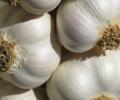
While onion prices eased a little by Rs 10 a kg in Delhi on Thursday, citizens continued to be battered by high rates of other important vegetables like tomato and garlic, which are becoming out of reach for common man.
The empowered group of ministers on fuel pricing is to meet this week to take a view on the price of diesel.
 © 2026 Rediff.com - Advertise with us - Disclaimer - Privacy Policy - Sitemap - Feedback - About us - Terms of use - Grievances